The Grid
For the problem you keep repeating without ever quite understanding.
You already know what to do.
So why do you keep not doing it?
A field guide to the fight happening inside you, plus ten working instruments to use on yourself.
Each one worked for a while.
Then came an ordinary Tuesday.
You were tired. You were irritated. You wanted relief. You wanted someone to approve of you. You didn't feel like doing the thing you said mattered.
And the worst part is that you already knew better.
Then came the familiar explanation:
“I'll start again tomorrow.”
That isn't a lack of information.
And it isn't always a lack of discipline.
Something else has the seat.
Maybe it's your pride. Your comfort. Your need to be approved of. Your need to stay in control. Your need to protect the version of yourself you think you have to be.
These aren't simply bad habits waiting for a stronger system.
They're ways of protecting something.
And until you see what is being protected, you can keep improving the system forever without touching the thing actually running it.
Here is the uncomfortable part:
Self-improvement is exactly what the ego is willing to do.
As long as it gets to keep the seat.
You can build the perfect morning routine and still be ruled by one person's opinion.
You can become incredibly disciplined and still spend half your day protecting your image.
You can become “better” while becoming even more attached to being the person who is better.
That's the trap.
You keep upgrading the person in the seat without asking who is sitting in it.
The answer isn't new.
Long before productivity culture, the Christian ascetic tradition was studying the movement from thought to temptation, from temptation to agreement, and from agreement to action.
The desert fathers paid extraordinary attention to the inner conversation most people barely notice.
The Seat takes that way of looking at the inner life and puts it into the language of ordinary modern life.
You don't need another system for forcing yourself harder.
You need to see where you keep handing over authority without realizing you did it.
Not through willpower. Through surrender.
The book
You may be fighting the loudest problem while a quieter one runs the whole system.
Learn how to find what actually keeps taking the seat.
A thought appearing is not the same as agreeing with it.
Learn to recognize the movement from first impression to consent, and find the point where you still have a choice.
A mood. A person. A notification. A fear. A desire.
Something can start directing your behavior long before you consciously decide to obey it.
Learn to notice the transfer of authority.
Discipline is useful.
It also makes a very convincing idol.
Learn how to train yourself without turning discipline itself into something you worship.
Failure can become another place for the ego to take over.
Pride says, “I shouldn't have fallen.”
Despair says, “This proves what I am.”
Learn the harder movement between them: return.
Notice. Discern. Surrender. Obey. Return.
The sequence is simple.
Living it is not.
The book shows you what those movements look like when the problem is no longer theoretical.
The tools
Knowing what is wrong is not the same as seeing it in yourself. These are designed for the part that happens after the insight.
For the problem you keep repeating without ever quite understanding.
For the behavior you desperately want to stop but somehow keep choosing.
For when your problems look different on the surface but somehow keep producing the same life.
See what is actually happening before you decide what to change.
For when something feels good now and leaves you worse later.
For when your system works perfectly until you are tired, distracted, discouraged, or human.
For when your stated priorities and your actual day have quietly become two different things.
For when one failure becomes a disappearance, then a lost week, then another restart.
For when you know something needs to end, but part of you is still standing in the doorway.
For when you want to find out what remains when nobody is watching.
Each instrument includes a short teaching, questions designed to surface what you normally miss, and an AI prompt you can use to push the analysis further.
You're not getting ten more worksheets.
You're getting ten ways to catch yourself.
Because the problem with most self-help is that you can understand every concept in the book and still protect yourself from every implication of it.
You can read about pride and think of someone else.
Read about comfort and immediately explain why your situation is different.
Read about surrender and turn it into another identity to be proud of.
These instruments are there to make the ideas concrete.
Not “What do I think about this?”
What is actually happening in my life?
The Living Board
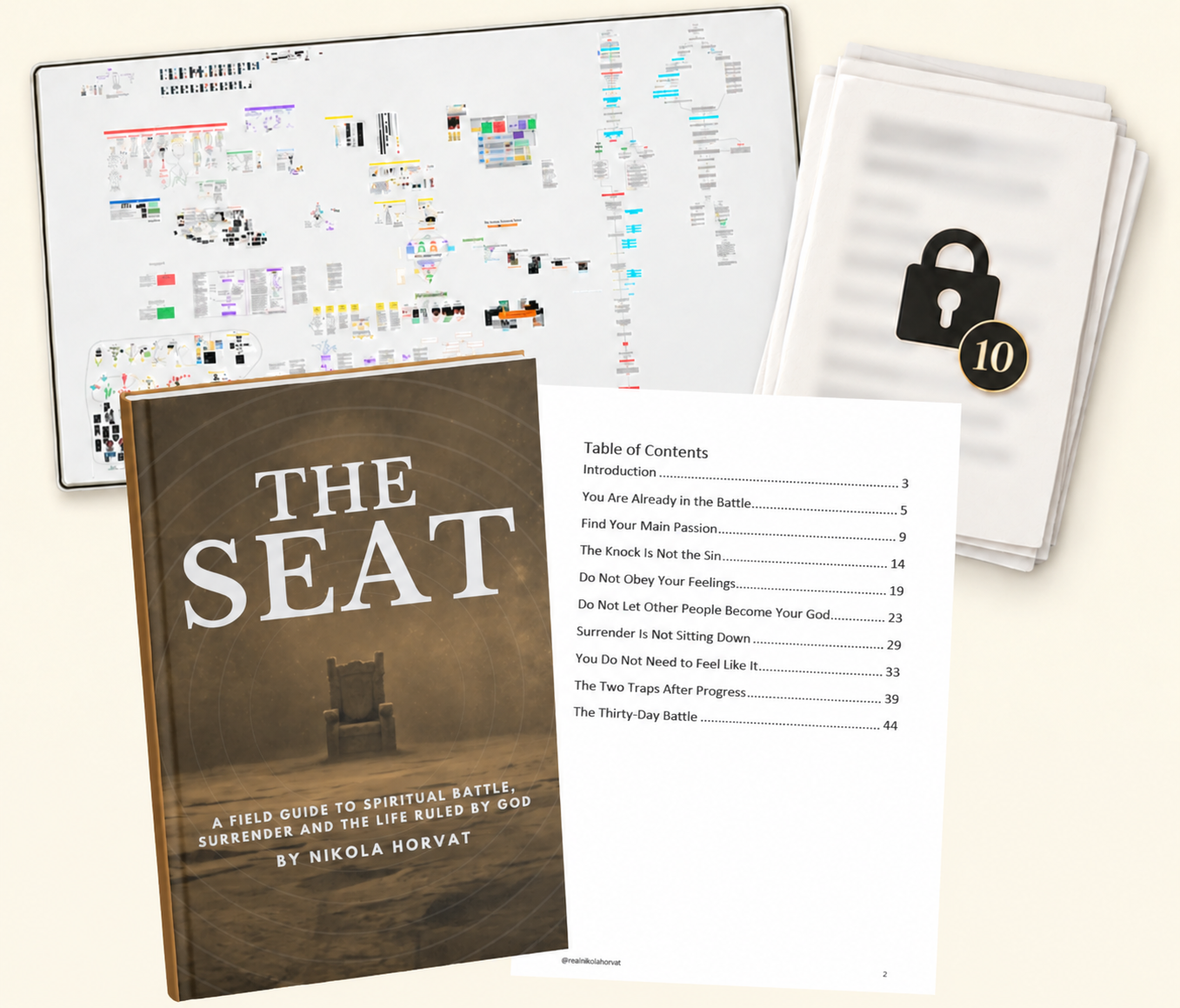
Included with The Seat is access to the Living Board, an evolving visual map of the system behind the book.
This is where I keep developing the framework beyond the pages: the ego, identity, attention, temptation, behavior, the twelve mechanisms, spiritual formation, recurring patterns, questions, connections, examples, and new observations.
The board is intentionally alive.
As the framework develops, the map develops with it.
You don't just get the finished book.
You get access to the thinking that continues after it.
Yes.
The Seat is explicitly Christian and draws heavily from the Christian ascetic tradition, especially the desert fathers.
You don't need to know that tradition beforehand.
But the book does not try to hide where its answer comes from.
You can read the book in an afternoon.
You probably shouldn't.
The instruments are designed to be used over time, because the point isn't to finish another PDF. It's to start noticing what happens in your actual life.
The book arrives as a PDF.
The ten working instruments are Google Docs, and the Living Board is on Miro. The links are inside the book.
For the app, you get a code that unlocks three months of Align Pro.
Each instrument has questions to fill out, and a full prompt you can copy and paste into an AI.
The book shows you what's in the way. Align: Identity & Habit System makes sure you actually do the work, every day, with proof.
Three months of Align Pro come with the purchase.
No.
The book is a 50-page PDF. The instruments and the Living Board are linked from inside it, so you can start immediately.
Think back five years.
Is the thing that ruled you then still ruling you now?
Maybe it has changed its clothes.
Different behavior.
Same seat.
And if the same thing keeps occupying it, a better routine will only help you become more efficient at living under it.
You can keep perfecting the mask.
Or you can finally turn around and ask the question everything else has been avoiding:
Who has the seat?
Get The Seat. Hand over the seat.
P.S. Don't start by reading everything in order. Start with The Payout Audit. Ask the question most self-improvement avoids: “What is this behavior doing for me right now?” Then follow the answer wherever it goes.